Table of content


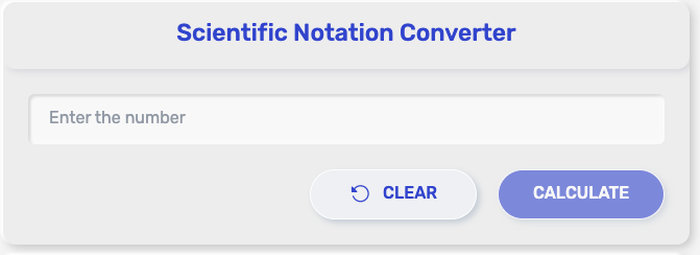
Convert numbers between scientific notation and standard form in seconds. This tool lets you switch from scientific notation to decimal, number, or standard notation with clear results and no manual calculation needed.
This tool is designed for quick conversions without any extra setup. Whether you're working with scientific notation, decimal numbers, or standard form, the process stays simple and consistent.
Enter a number in scientific notation or standard form
Choose the conversion type (to decimal, to scientific notation, or to number)
Click the “Convert” button
View the result instantly
Copy or reuse the output if needed
This tool is built to handle different types of number formats, so you’re not limited to just one kind of conversion. It works both ways and supports a wide range of values, from very small decimals to extremely large numbers.
Convert scientific notation to decimal form for easier reading
Convert scientific notation to standard form or full number format
Convert decimal to scientific notation for compact representation
Convert standard notation to scientific notation in seconds
Handle both positive and negative exponents accurately
Work with very large or very small numbers without losing precision
This makes it useful whether you're switching formats for schoolwork, data processing, or quick checks.
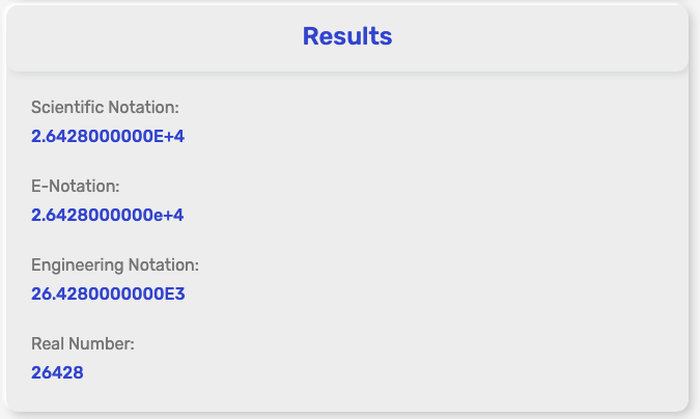
The result shows the same number in a different format based on the option you choose in the tool. The value does not change. Only the way it is written changes.
If you convert scientific notation to decimal, the output displays the full number without exponent form. If you convert a regular number to scientific notation, the result appears in a shorter format using powers of ten. When you switch scientific notation to standard form, the tool rewrites the value in a more familiar number style.
You can use the result for many practical tasks, such as:
checking math homework
reading large or very small values more easily
entering numbers into reports, calculators, or spreadsheets
rewriting data in a cleaner format for science or engineering work
Pay attention to the output format and decimal placement, especially when the exponent is positive or negative.
This scientific notation converter is often used in everyday study, technical work, and data handling where numbers can quickly become hard to read or write manually.
Solving math exercises that involve scientific notation or standard form
Converting scientific notation to decimal for easier visualization
Writing very large numbers (like distances or populations) in a shorter format
Expressing very small values in chemistry or physics calculations
Preparing numbers for calculators, spreadsheets, or reports
Double-checking manual conversions to avoid decimal placement mistakes
It’s especially useful when speed and accuracy matter, and you don’t want to deal with moving decimal points by hand.
These two formats represent the same value, but they are written in different ways depending on the situation.
Scientific notation uses powers of 10 to shorten long numbers
Standard form shows the full number without exponents
Example:
Scientific notation: 5 × 10⁵
Standard form: 500,000
Scientific notation is often used when numbers become too large or too small to write comfortably. Standard form is more common in everyday use, where readability matters more than compactness.
The converter lets you switch between scientific notation and standard form instantly, so you can choose the format that fits your task.
Scientific notation is a way to write very large or very small numbers in a shorter and more readable form. Instead of writing out many zeros, the number is expressed using a base value and a power of 10.
For example:
3 × 10⁶4.5 × 10⁻⁴Each part of the notation has a role:
When the exponent is positive, the number is large. When it is negative, the number is very small. This format is commonly used in science, engineering, and calculators because it keeps numbers clean and easier to compare.
If you are not familiar with how the conversion works step by step, the video below gives a quick visual explanation using simple examples.
Scientific notation becomes useful when numbers are difficult to read or write in their full form. Instead of dealing with long strings of zeros, you can express values in a cleaner and more compact way.
Numbers are too large to write easily (like 5,000,000,000)
Numbers are extremely small (like 0.00000032)
You need precise representation in calculations
You want a more organized format for data
This format is commonly used in:
Physics for measurements like distance or energy
Chemistry for atomic and molecular values
Engineering for technical calculations
Data science when handling large-scale datasets
Even though the tool gives instant results, it’s still useful to know what to watch for when working with scientific notation.
Always check whether the exponent is positive or negative
Make sure the coefficient stays between 1 and 10
Be careful when moving the decimal point left or right
Double-check results when working manually
Use the converter to avoid small but common mistakes
These small checks can prevent errors, especially when dealing with very large or very small numbers.
Weisstein, E. W. (n.d.) – Scientific Notation
https://mathworld.wolfram.com/ScientificNotation.html
National Institute of Standards and Technology (NIST) – Guide for the Use of the International System of Units (SI)
https://www.nist.gov/pml/special-publication-811
OpenStax (n.d.) – Scientific Notation
https://openstax.org/details/books/algebra-and-trigonometry
Khan Academy (n.d.) – Scientific Notation and Conversions
https://www.khanacademy.org/math/algebra
Stewart, J. (2015) – Calculus: Early Transcendentals
https://www.cengage.com/c/calculus-early-transcendentals-8e-stewart/
Move the decimal point to the right if the exponent is positive, or to the left if the exponent is negative, based on the exponent value.
Yes, it works with extremely large and very small values without losing accuracy.
Rounding is optional. You can keep the full precision or round depending on your needs.
Manual errors often come from incorrect decimal movement or exponent signs. The tool eliminates those mistakes.
You can enter numbers in scientific notation (like 2.5 × 10³) or standard decimal format (like 2500).
Scientific-notation-converter.com was built to make number conversion easier when standard formats become harder to read. From classroom exercises to scientific calculations, this tool helps users quickly switch between scientific notation and standard number form with clarity and confidence.
This tool was created by the Scientific-notation-converter.com team, with contributions from developers, educational content creators, and technical specialists who work together to turn complex mathematical tasks into simple digital solutions. We believe useful tools should do more than calculate—they should make information easier to understand, easier to use, and easier to trust.
We believe technical tools should be simple to use, clear in purpose, and trustworthy in how they work.
Scientific-notation-converter.com does not require registration or personal information. Any values entered into the tool are used only to perform the conversion and are not stored or shared.
This tool is designed to provide quick and reliable conversions between scientific notation and standard number format. While every effort is made to ensure accurate results, users should review outputs when using them for academic work, scientific calculations, reports, or other precision-based tasks.
The converter is meant for learning, reference, and everyday problem-solving. It is a helpful support tool for working with large and small numbers, but it should not replace careful review in situations where exact formatting or precision is essential.
We may update this Policy from time to time to reflect improvements to the tool or related practices. Any changes will be posted here so the information remains clear and up to date.